Roundabouts in Plain Terms
A roundabout is a circular intersection where vehicles travel around a central island and enter by yielding to circulating traffic. Drivers typically slow on approach, merge into the circulating lane, and exit by choosing the correct exit before leaving the circle. In many places, the yield-to-circulating rule replaces traffic signals for many movements, which changes how queues form and how long vehicles wait.
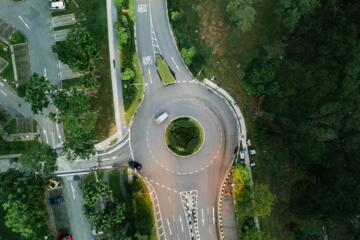
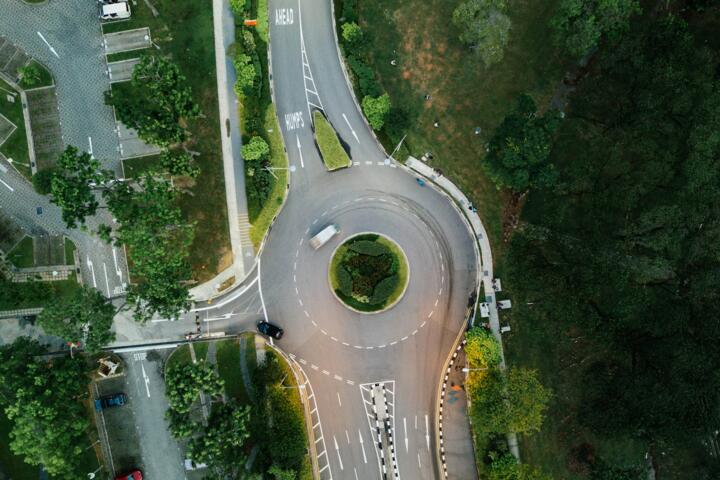
In the UK, the Department for Transport reports that roundabouts have about 40% fewer fatal and serious injuries than comparable signal-controlled junctions, based on reported casualty patterns (the exact figure varies by study and site type). In the US, the Federal Highway Administration summarizes research showing that roundabouts generally reduce injury crashes, with the biggest safety gains for right-angle collisions. A measurable design feature is the splitter island: it separates entering and exiting traffic and guides drivers into a slower entry path.
Speed control is the mechanism.
Roundabouts reduce conflict severity by lowering speeds at the crossing points where vehicles would otherwise meet head-on or at right angles. The geometry forces drivers to turn through a curved path, so the entry speed drops compared with a straight-through approach at a typical signalized intersection. The number of conflict points also changes: a simple four-leg roundabout has fewer crossing conflicts than a four-way intersection with signals, because vehicles share a single circulating stream rather than multiple independent phases.
Capacity depends on demand.
Traffic flow outcomes depend on design and traffic volumes. A single-lane roundabout can handle moderate volumes, but heavy demand during peak hours can create long queues that spill back toward upstream intersections. Multi-lane roundabouts and signalized roundabouts can improve throughput, yet they require careful lane discipline and clear signage. If you have ever watched a queue grow at a busy entry, you have seen the same physics: arrivals keep coming while gaps in the circulating stream stay scarce.
Main Problems Drivers Face
Many people approach roundabouts like they are mini traffic circles with lane changes allowed at any time. That mindset breaks down because the circulating lane is a moving priority stream, and late lane changes increase side-swipe risk. Another common error is misreading the yield rule: yielding to circulating traffic is not the same as stopping immediately, and the correct behavior depends on whether there is a safe gap.
Speed mismatch causes most trouble.
Biologically, crash risk rises when drivers make late decisions under time pressure. A roundabout compresses decision time because you must judge gaps while steering through a curve. If a driver enters too fast, the gap that looked acceptable while approaching can disappear once the vehicle is committed to the turn, which increases the chance of a sudden braking event or a contact with the circulating vehicle. This is why approach speed control matters more than “confidence” and why signage and markings are treated as part of the safety system.
Supporting technologies matter too.
Design elements such as entry width, curvature, central island size, and splitter island length determine how much speed reduction happens before the yield point. Markings and signs guide lane selection, while lighting and pedestrian crossings affect how drivers manage attention. Some jurisdictions add signal control at specific entries, which changes the gap-acceptance behavior and can reduce queue spillback, but it also reintroduces stop-and-go patterns.
Design choices change outcomes.
Capacity is not a fixed number. It depends on circulating flow, entry lane count, vehicle mix (buses and trucks create different gap needs), and driver compliance with lane discipline. When a roundabout is undersized for peak demand, queues can form and block nearby access roads, which can worsen overall network performance. That network effect is easy to miss when you only watch one intersection.
Solutions and Recommendations
Approach slower, read signs
Drive to the posted speed and treat the entry as a speed-control zone, not a place to “thread the needle.” The reason is mechanical: the curve and splitter island geometry are designed to reduce entry speed, and your steering and braking decisions must match that path. In practice, you should scan for lane-control arrows and exit lane markings before you reach the yield line, because lane changes inside the roundabout often create conflicts. If your car has a navigation system, check whether it shows the correct exit lane early; on my phone, a 2024 map update sometimes delayed lane guidance by a few hundred meters, which is enough to cause a wrong-lane entry.
Slow entry reduces conflict.
Yield correctly at the line
Yield to circulating traffic at the marked yield line, then enter when you find a safe gap. This works because the circulating stream is the priority flow, and the yield rule prevents two vehicles from occupying the same space at the same time. In practice, you should avoid rolling forward past the yield line if you cannot judge gaps clearly; a short pause improves your visibility and reduces rushed decisions. If there is no gap, wait—queueing at the entry is part of how the intersection manages demand.
Wait beats a risky merge.
Choose the exit lane early
Pick the correct lane before you pass the exit you plan to take, based on lane arrows and signage. The reason is that lane discipline reduces side-swipe risk and keeps vehicles from cutting across the circulating flow late. In practice, you should signal your exit intention only when your jurisdiction’s rules match that behavior, and you should avoid sudden lane changes near the exit. Some roundabouts have lane drops or painted gore areas; those markings are not decoration, they are a conflict-management tool.
Lane choice prevents last-second moves.
Use mirrors and head checks
Scan mirrors for vehicles behind you, then do a head check for blind spots before entering and before any lane change. This works because roundabouts often involve lateral movement and merging, and mirror-only scanning can miss vehicles in adjacent lanes. In practice, you can reduce workload by slowing earlier on approach so you have time to look, not just time to steer. If you drive a vehicle with a wide A-pillar, you may need a slightly longer head check; that extra second matters when gaps are short.
Look early, then commit.
Plan for pedestrians and cyclists
Approach crossings with extra caution and treat pedestrian signals and refuge islands as part of the traffic control. The reason is that pedestrians and cyclists interact with driver attention at the same time drivers must judge gaps in traffic. In practice, you should slow before the crossing zone, watch for people stepping off the curb, and avoid accelerating through a crossing just because you have the right-of-way. Some roundabouts include raised crossings or zebra markings; those features change driver expectations and braking distances.
Crossings add decision load.
For drivers: avoid late braking
Brake smoothly and early if you need to slow for yield gaps, pedestrians, or lane changes. This works because abrupt braking increases rear-end risk and can create unstable gaps for the vehicle behind you. In practice, you can time your approach by using the splitter island as a reference point: if you need to brake hard right at the yield line, your approach speed was too high. I have seen drivers blame “bad luck” when the real issue was entering at a speed that left no room for safe gap acceptance.
Hard braking signals bad planning.
For planners: match design to demand
Choose roundabout type and geometry based on traffic volumes, vehicle mix, and turning movements rather than copying a standard layout. The reason is that capacity and safety trade off with design: tighter entries reduce speed but can increase friction for large vehicles, while wider entries can raise entry speeds and reduce safety benefits. In practice, engineers use traffic counts and turning movement data to size lanes and determine whether a single-lane, multi-lane, or signal-controlled roundabout fits. A common measurable target is to keep entry speeds low enough to reduce injury severity, often by shaping curvature and using splitter island length.
Design must fit the peak.
Examples from Real Settings
Urban entry queue during peak
An anonymized city installed a single-lane roundabout at a four-way junction with heavy morning inflow. During the first 2 weeks, drivers reported “stop-and-go” behavior at one entry, and traffic cameras showed queues that reached nearby side streets. The underlying issue was not the roundabout concept; it was insufficient circulating capacity for that peak demand and a high proportion of long vehicles that required larger gaps. After retiming nearby upstream signals to reduce simultaneous arrivals, the queue length dropped, and drivers reported fewer forced merges.
Queues can reveal sizing gaps.
Wrong-lane entries after lane markings changed
A suburban road converted a signalized intersection to a roundabout and added lane-control arrows. In the first month, a subset of drivers entered the wrong lane because they relied on older navigation guidance and ignored the new painted arrows. The result was more lane changes inside the circle, which increased minor side-swipe contacts. The fix involved clearer advance signing and a short period of public guidance, while the geometry remained unchanged. The lesson: markings and driver information are part of the safety system, not an afterthought.
Information quality changes outcomes.
Comparison Choices Checklist
| Option | What it changes | Typical driver experience | Main risk to watch |
|---|---|---|---|
| Single-lane roundabout | One circulating stream; gap acceptance at entries | Continuous movement with entry yielding | Long queues at peak if demand exceeds capacity |
| Multi-lane roundabout | Multiple circulating lanes; lane discipline becomes critical | More lane selection before entry | Side-swipe risk if lane changes occur late |
| Signal-controlled roundabout | Signals meter entry gaps | Stops at certain entries, fewer surprise gaps | Stop-and-go patterns and driver confusion if signage is unclear |
| Keep signals | Phased movements; predictable right-of-way | Frequent stops, phase-based flow | Higher severity for right-angle collisions in some layouts |
Pick based on measured demand.
- Collect turning movement counts for peak 15 minutes and the full hour.
- Check vehicle mix, including buses and trucks, because they affect gap needs.
- Review crash history by movement type, not just total counts.
- Confirm lane-control signage and markings match the chosen roundabout type.
- Plan for pedestrian and cyclist crossing design and driver sight lines.
Mistakes that Reduce Safety
Drivers often treat the yield line as optional and roll forward to “test” the gap. That behavior increases the chance of forcing a circulating vehicle to brake, which can create a chain reaction of late decisions. Another mistake is signaling too late or signaling inconsistently with local rules, which can confuse other drivers about exit intentions. Lane changes inside the roundabout, especially near exits, create lateral conflict points that the design tries to avoid.
Late lane changes are risky.
Some drivers also misjudge pedestrian crossings by focusing on the vehicle gap rather than the crossing zone. If a pedestrian steps off the curb, the driver’s attention must shift quickly, and the braking distance depends on approach speed. In addition, drivers sometimes enter too fast because they expect the roundabout to behave like a free-flow slip road. That expectation conflicts with the geometry designed to slow vehicles, so the result is abrupt braking or contact.
Navigation errors happen, too.
For planners and maintenance teams, a common mistake is leaving outdated signs or markings after conversion. Drivers who rely on older guidance can enter the wrong lane, and the roundabout then becomes a conflict generator rather than a conflict reducer. Poor lighting, faded paint, or missing advance direction signs can also degrade performance, especially at night or in rain. A small aside from field observation: paint that looks fine in daylight can become hard to read under glare, which is why retroreflectivity checks matter.
FAQ
Do roundabouts reduce crash severity?
Research summaries and government reports commonly find fewer injury crashes and fewer fatal or serious injuries compared with similar signalized intersections, but the size of the benefit varies by design, traffic volumes, and road user mix.
How do I choose the correct lane?
Use the lane-control arrows and exit markings before you reach the entry. If the roundabout has multiple lanes, lane choice should happen on approach, because late lane changes inside the circle increase side-swipe risk.
When should I yield versus stop?
At the yield line, you yield to circulating traffic and enter only when a safe gap exists. You may stop if no safe gap appears, but you should not assume a stop is required when a gap is available.
Can roundabouts handle heavy traffic?
They can, but capacity depends on circulating flow, entry demand, lane count, and vehicle mix. If peak demand exceeds capacity, queues can form and spill back, which can worsen network performance.
What about pedestrians and cyclists?
Crossing design and driver attention determine safety. Drivers should slow for crossing zones, watch for people stepping off curbs, and follow local rules for yielding to pedestrians and cyclists.
Author's Insight
Roundabouts change traffic flow through geometry and priority rules, not through a single “magic” feature. The yield-to-circulating design shifts conflict patterns from right-angle crossings to lower-speed merging and turning movements. Safety outcomes depend on driver behavior, lane markings, and whether the roundabout is sized for peak demand; a poorly matched design can trade fewer severe crashes for longer queues. When evaluating a specific site, look at entry speeds, lane-control clarity, pedestrian crossing placement, and crash history by movement type, then compare those facts to the roundabout type.
Design and behavior interact.
What to Remember
Roundabouts improve traffic flow by reducing stop-and-phase complexity and lowering conflict severity through speed control and geometry. Drivers should approach slowly, yield correctly at the line, choose the correct lane before entry, and treat crossings as attention-heavy zones. Limits exist: peak demand can exceed capacity and create queues, and multi-lane designs require strict lane discipline. If you are evaluating a roundabout for a community or commute, start with measured traffic counts and lane-control clarity, then review crash patterns by movement type.
Next steps: observe, then adjust.
- For drivers: practice lane selection and gap judgment on low-traffic routes.
- For planners: verify signage, markings, and sight lines after construction.
- For anyone involved in safety review: request data on peak queues and crash types, not only totals.
If you have a medical concern after a crash, seek professional medical advice based on symptoms and local emergency guidance; traffic engineering choices cannot replace clinical evaluation.